The Brain That Proved Itself
Santiago Ramón y Cajal's Long Path to Greatness


Santiago Ramón y Cajal in his laboratory (ca. 1885), Wikimedia Commons
The Illusion of Destiny
"Early in the morning on Friday, October 26, 1906, there was a knock at Cajal's front door. Silveria rose from bed and received a telegram. She woke Cajal and relayed the message to him, which consisted of five German words: Carolinsche Institut vertichen Sie Nobel-priess—'Karolinska Institute awards you Nobel Prize.' Certain that his students were playing a trick on him, Cajal went back to sleep." [1]
Santiago Ramón y Cajal became one of the founders of modern neuroscience. His research on histology proved that the brain is made of individual cells, not a continuous network. He shared the 1906 Nobel Prize for this discovery.
From the outside, this looks like the culmination of obvious genius. But rewind the tape, and there's nothing inevitable about it.
This is a story about a rebellious kid who hated school, failed at formal education, and didn't find his calling until his mid-thirties. A story full of wrong turns, dead ends, and stubborn persistence against the odds.
If you've ever doubted whether you're on the right path—whether it's too late, whether you lack the obvious gift—Cajal's life offers something rare: genuine hope. Not the cheap kind that promises quick success, but the kind built on evidence that minds grow, skills compound, and the positive reinforcement loop—where enjoyment fuels practice, practice builds competence, and competence deepens enjoyment —can ignite long after others have given up on you.
The Fortified Castle
Santiago's father Justo, was born into an illiterate family. But he was determined to climb. He taught himself to read and trained his memory. He started as a barber-surgeon—the lowest rung of medical practice—then passed exams to become a certified surgeon. His dream was to reach the top: a physician.
He enrolled in a doctoral program at Barcelona. Then bad luck struck. He injured his leg during civil unrest and was forced to return home. He took a surgeon job, married Antonia, and started a family. But the dream of becoming a physician never died.
Santiago was born in 1852, followed by a younger brother and sister. Justo, regretful about his own late start, poured everything into his son's intellectual development. He believed even stubborn children could succeed if directed properly. Before mandatory schooling began at six, he was already tutoring Santiago in a cave—geography, arithmetic, grammar, and French.
Santiago was disorganized and restless. A small devil, they called him.
When Justo finally achieved his doctoral degree, the family's fortune changed. But now he was too busy to tutor. They moved to Ayerbe for better schooling. Thanks to his early lessons, Santiago was ahead of his peers academically. Socially, he was lost. "Things always interested me more than people," he later wrote. He had no friends except his brother Pedro. Classmates mocked him. The school demanded discipline and memorization—nothing that captured an eight-year-old who wandered the countryside alone.
He couldn't focus on what didn't interest him. But he could draw for hours.
He scribbled constantly—on scraps, textbooks, gates, walls, doors. He scrounged money for paper and pencils, paused during his solitary walks to sketch the scenery. At ten, he declared he wanted to be an artist.
His father didn't take it well. Art was a hobby, not a profession. When Santiago became a doctor, Justo said, he could spend his spare time on any hobby he liked. Until then: no. He confiscated the drawing tools. He burned the drawings.
Santiago had no interest in further formal education. His father sent him anyway—to the Institute of Jaca, a religious school known for its Latin program. Spanish secondary education at the time discouraged individualism and punished critical thinking. Physical punishment. Whipping. Daylong fasts for errors. Public shaming.
Santiago's poor memorization skills—the opposite of his father's gift—made Latin a torture. He approached classes trembling with fear.
In this hostile environment, he retreated to his safe oasis: fantasy, nature, and drawings. "When the world does not accept us," he wrote later, "we can build a castle of our dreams."
By the end of the year, he stopped going to school entirely.
Justo recognized that terror had failed. He agreed to be more lenient. Santiago passed his exams with the lowest possible grades and transferred to Huesca, where teachers still used punishment, but not terror. And no Latin.
Huesca opened a window to culture: bookstores, libraries, and the river where Santiago sat sketching. At the institute, he finally found a subject he enjoyed: geography. It involved drawing. Copying maps. His visual memory—his version of his father's verbal gift—came alive.
He still passed exams with poor grades.
His young life became a constant pattern: resisting his father's pressure while finding small opportunities to keep doing what he loved. When grades didn't improve, Justo tried a different cure—he apprenticed Santiago to a cobbler. Drawing tools were confiscated again.
But Santiago excelled. He learned to make ornamental toecaps and considered himself a shoe artist. After the apprenticeship, Justo believed his son was finally healed from "artistic madness." In 1867, he allowed Santiago to return to Huesca.
This time, Santiago negotiated. He asked to enroll in a drawing course—useful for doctors and engineers, he argued. Justo agreed, on one condition: Santiago had to work at a barbershop.
It was worth it. The arts program in Huesca had a strong reputation, and its founder—León Abadías, a painter—became the mentor Santiago had been missing. For the first time, someone took his artistic impulse seriously. Santiago threw himself into the work. He became the most brilliant pupil. Great grades. Prizes.
The drawing hadn't been cured. It had found a home.
The Tipping Point
In 1868, Justo decided it was time to start medical education. Santiago learned anatomy through direct experience—taking bones from cemeteries, comparing them with anatomy books. He was good at osteology. The bones became another subject for his pictures.
In medical school, he met teachers who expanded his horizons—who showed that the world of knowledge could be captivating.
Florencio Ballarín taught natural history through classification by sight, not memorization. Teaching objectively, with experiments. Bruno Solano, the chemistry teacher, was a polymath—history, literature, philosophy, art, sciences, and law. He questioned students' habitual thinking. He taught chemistry by telling stories. He showed Santiago that science could be as interesting and adventurous as literature and fiction.
Something was shifting.
Justo found a job in Zaragoza and began providing dissection classes at Santiago's school. In the afternoons, father and son spent hours in the dissection room studying anatomy together:
"Page by page, they forged through the same mammoth textbook, meticulously dissecting muscles, blood vessels, nerves, and viscera, checking the authors' findings against their own. His father's explanations were pithy and serious, stripped of all rhetorical fat, leaving nothing but the bare bones. Sometimes they would come upon a new detail that no author had noted before. No pleasure could compare to the joy of discovery, Cajal said. It was a thrill that he first shared with his father." [1]
With each new anatomical structure uncovered, Santiago did what he always did when encountering something new: he drew it. Only now, instead of rocks, flowers, and trees, he turned his eye toward ganglia, sheaths, and plexuses. His notebooks were filled with hundreds of drawings—pencil sketches, watercolors, colored pencil illustrations.
The skills were compounding. Drawing had kept him in the game. Now it was becoming something more.
Reading about ideas was never enough for Santiago. He had to see for himself. Microscopes weren't widely used at the time, dismissed by conservatives. But Santiago was astonished by what they could reveal.
In 1877, he visited Aureliano Maestre's anatomy and histology laboratory, where microscopes were central tools. He called microscopic anatomists "Columbuses"—explorers of an invisible world. He dreamed of owning his own microscope. It cost half his yearly salary.
When he finally got one, he stayed up all night playing with it like a child with a new toy. Whatever he inspected—tissue, blood, saliva, plants—he found cells. He fell in love with biological research.
His father arranged a surgeon job for him in a small village. Santiago accepted to avoid embarrassment, but returned after several months. He didn't want to practice medicine. He wanted to focus on histology.
The loop of scientific research had ignited.
Total Immersion
"The laboratory is the ideal sanatorium," Cajal wrote. [1]
He spent more and more hours locked in his attic, working with newfound vigor. No assistants, no collaborators, no noise. While universities closed at night, his attic remained open. Books became his mentors—"forever wise and calm, and unlike people, they know how to keep quiet after saying their piece."
Now, Cajal was master and apprentice both.
He channeled his most powerful character traits—obsessiveness, competitiveness—into his scientific practice. He calculated the time a task required, then devoted ten times more. For the time being, there was no one to surpass but himself. He considered that triumph the only one worth celebrating.
"Laboratory work consumed Cajal. He went to sleep late and woke early, unable to divert his mind from the microscope in the other room. He stopped going to the café, almost completely withdrawing from the world... Colleagues, classmates, and professors, who acknowledged his hard work and talent, nonetheless mocked him for his quixotic, solitary pursuit. 'Fortunately,' Cajal said, 'I have endured the absence of social life quite well.'" [1]
In Barcelona, he published 43 papers in four years. He founded his own journal when delays frustrated him. He sent copies to leading scientists abroad. At first, silence. Then recognition came—slowly, then all at once.
Twenty-five years after nearly failing secondary school, Santiago became a model student again. In his forties, he audited philosophy, law, and history classes—not for credentials, but for curiosity.
"Before discovering anything," he wrote, "we must first discover ourselves."
His great discovery was proving what the scientific establishment denied: the brain is not a continuous network, but made of individual cells—neurons—that communicate across tiny gaps. He drew what he saw through the microscope with such precision that his illustrations became scientific evidence. The same skill his father once burned as worthless now revealed the structure of the mind.
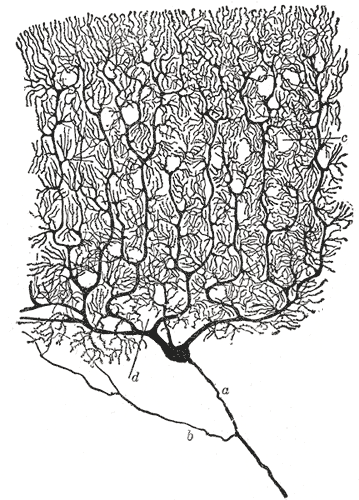
Purkinje neurons drawing, Wikimedia Commons
In 1906, the telegram arrived. He thought it was a prank and went back to sleep.
He shared the Nobel Prize with Camillo Golgi, the man whose staining technique he had mastered, and who still disagreed with his findings. At the ceremony, Golgi used his speech to attack the neuron theory. Cajal used his to defend it.
The rebellious boy who couldn't memorize Latin had proven how the brain works.
The Long Game
What does Cajal's story actually tell us?
Not that natural abilities don't matter. He had real ones—visual memory, obsessive focus, competitive drive. But they weren't obvious in childhood. They emerged slowly, shaped by circumstance, built on skills that seemed useless at the time.
The loop doesn't ignite immediately. Sometimes you need years of scaffolding before finding the tool or context that makes everything click. Drawing kept Santiago in the game when school pushed him out. It gave him enough enjoyment to persist. Then drawing opened the door to anatomy, anatomy to microscopy, microscopy to neuroscience. Each skill enabled the next. He climbed a ladder that he couldn't see.
This is how it often works. You acquire one skill that lets you enjoy another activity. That activity opens doors to new skills. You can't skip the rungs. Craft precedes art. Tools precede discovery. People want to be creative and innovative from the beginning, but you need to be capable first.
His character traits transformed along the way. The stubbornness that infuriated his father became persistence in the laboratory. The competitiveness that made him difficult became the drive to outwork everyone. The same qualities that made him a problem child made him a great scientist.
In his Advice for a Young Investigator, Cajal addressed those who thought he overemphasized willpower at the expense of natural genius:
"I would be the last to deny that the greatest scientific pioneers belonged to an aristocracy of the spirit and were exceptionally intelligent, something that we as modest investigators will never attain, no matter how much we exert ourselves. Nevertheless... I continue to believe that there is always room for anyone with average intelligence and an eagerness for recognition to utilize his energy and tempt fate. Like the lottery, fate doesn't always smile on the rich; from time to time it brings joy to the homes of the lowly." [2]
Great natural abilities make you faster. But ordinary minds can still arrive, just slower. What you lack in one area, you can compensate with strengths in others. Santiago couldn't memorize like his father. So he drew instead. His visual memory wasn't handed to him—it was built, hour by hour, sketch by sketch.
Late doesn't mean never. His obsession with neuroscience didn't arrive until his mid-thirties. Before that, nothing fully captured him. The boy who hated learning became a man who audited philosophy, law, and history classes in his forties—for curiosity alone.
His life demonstrated what his research established: minds grow under the right conditions. The brain is not a fixed network. New connections form. New capabilities emerge. That was the whole point of his science—and the whole arc of his life.
The brain that proved itself.
References
[1] Benjamin Ehrlich, The Brain in Search of Itself: Santiago Ramón y Cajal and the Story of the Neuron (2022)
[2] Santiago Ramón y Cajal, Advice for a Young Investigator (1999)


